

The lovely holiday island, located in beautiful surroundings in the central Jutland lake area of Julsø opposite Himmelbjerget, has installed an environmentally friendly wastewater system for a total of 5 buildings on the island. Including a summer camp with 55 beds, a larger cabin for 10 people and three private summer houses.
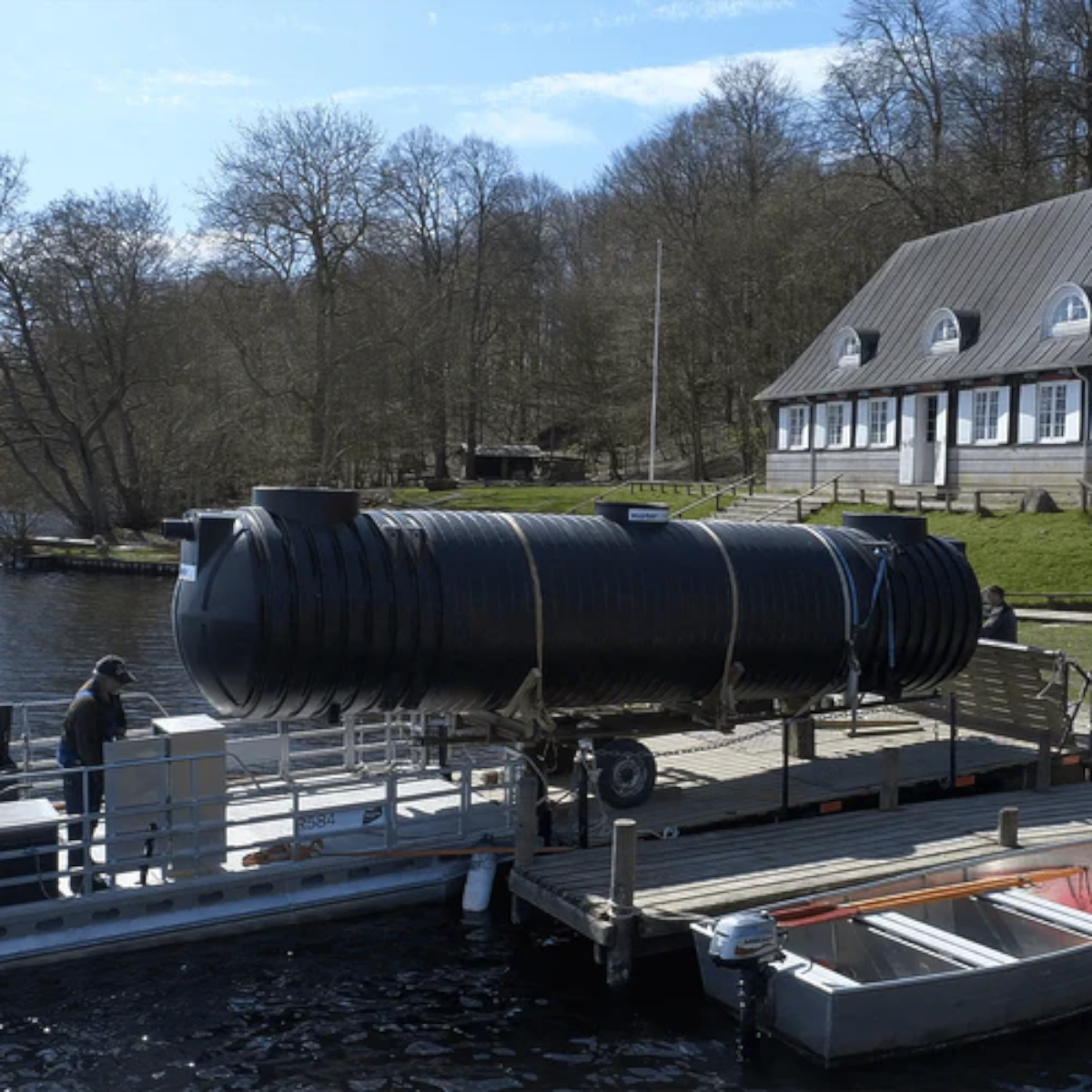
It was therefore a strange, almost submarine-like sight that passersby could spot on the water towards Møgelø on April 17, 2020. Here, the first of the two sedimentation tanks, measuring 7.2 and 8.5 m (12 and 14 m3), was transported to the island on a raft that Møgelø volunteers had built for the purpose, including eight used oil tanks.
The two large sedimentation tanks were picked up that very morning from the manufacturer WaterCare in Assens on Funen, after which they were transported to the landside at Gl. Laven in Silkeborg opposite Møgelø. Here, the first of the two sedimentation tanks was carefully placed by crane on a specially made trailer and, as if the idyllic area with Himmelbjerget in the background were not enough, the trailer was then pulled down to the fleet by Møgelø's nostalgic Ferguson tractor, whose original paintwork was not easy to see through.
Since Møgelø was connected to the water supply from the mainland in 2013, the island's volunteers have investigated several different options for disposing of wastewater.
"In this context, Møgelø is quite unique, as it is not possible to empty the sedimentation tanks annually by ferry, as is done on other Danish islands. Møgelø has also been offered a connection to the public sewer system, but we would have to be responsible for transporting the wastewater from the island to the nearest existing connection option ourselves. In addition to the challenges of crossing both the lake and the railway, it would be far too expensive to establish and maintain this solution,"
The two large sedimentation tanks from WaterCare form a central part of the new and environmentally friendly wastewater treatment plant on the island. The sedimentation tanks are dug into the top of Møgelø, where the wastewater from the island's 5 buildings is collected via a well with a pump and a knife located at each building. From the sedimentation tanks, the island's wastewater is handled and filtered in an environmentally friendly manner, and the plant also requires very little in operation and maintenance.